ai assessment creation.
মূল্যায়ন সৃষ্টি Assessment CreationDesigning Self Serve Intelligence for Assessment Creation
Role
Lead UX Designer · UX Strategy
Company
Naukri.com / Doselect
Product
DoIQ Assessor
Tools
Figma · Jira
why did this problem matter?.
সমস্যার মূল্যwhy it matteredDoSelect already had an assessments product backed by a large question library for both tech and non-tech roles. On paper, the system worked.
In reality, assessment creation depended heavily on a Content & Delivery (C&D) team, who collaborated with recruiters and hiring managers to manually curate tests.
This led to:
- Multiple back-and-forth cycles for every assessment
- High turnaround time
- Recruiter dependency on hiring managers for basic inputs
- Lost customers because the system couldn't scale with demand
Recruiters lacked the confidence and domain knowledge to create assessments on their own, making the experience slow, opaque, and operationally expensive.
This wasn't just a UX problem — it was a scalability and automation problem.
what were we really trying to solve?.
লক্ষ্যthe goalAt its core, the challenge was to move DoSelect from a service-assisted workflow to a self-serve, AI-assisted experience — without sacrificing assessment quality.
We needed to answer a few hard questions:
- How do we reduce dependency on the Content & Delivery team?
- How do we help recruiters think through assessment creation without overwhelming them?
- Where should AI assist, and where should humans stay in control?
- How do we design trust into AI-generated content?
how did we approach the process?.
প্রক্রিয়াprocessThis project required deep collaboration across Product, Engineering, and Content teams. My role focused on UX strategy and system design, not just screens.
Design process highlights:
- ▸Kicked off with PMs to review existing research, workflows, and experience gaps
- ▸Identified scope boundaries and design risks early
- ▸Shared early decision frameworks with the Content & Delivery team and iterated frequently
- ▸Presented direction and mental models to leadership — not just UI
- ▸Finalized flows, documentation, and handoff
- ▸Desk-checked production builds
- ▸Reviewed post-launch usage and feedback
This project evolved in public, with continuous iteration rather than a single "big reveal."
forms or conversations — how should recruiters create assessments?
সিদ্ধান্তthe decisionEarly exploration narrowed down to two possible directions: a structured, form-heavy flow, or a chatbot-based, conversational flow.
We chose the chatbot approach. Because recruiters don't think in rigid fields — they think in context, intent, and trade-offs. A conversational interface allowed us to:
- Capture inputs incrementally
- Reduce cognitive load
- Avoid the feeling of "filling yet another form"
- Feed richer context into the AI system
This decision became foundational to DoIQ's UX and AI strategy.
first iteration: library led automation.
First Conversation Flow
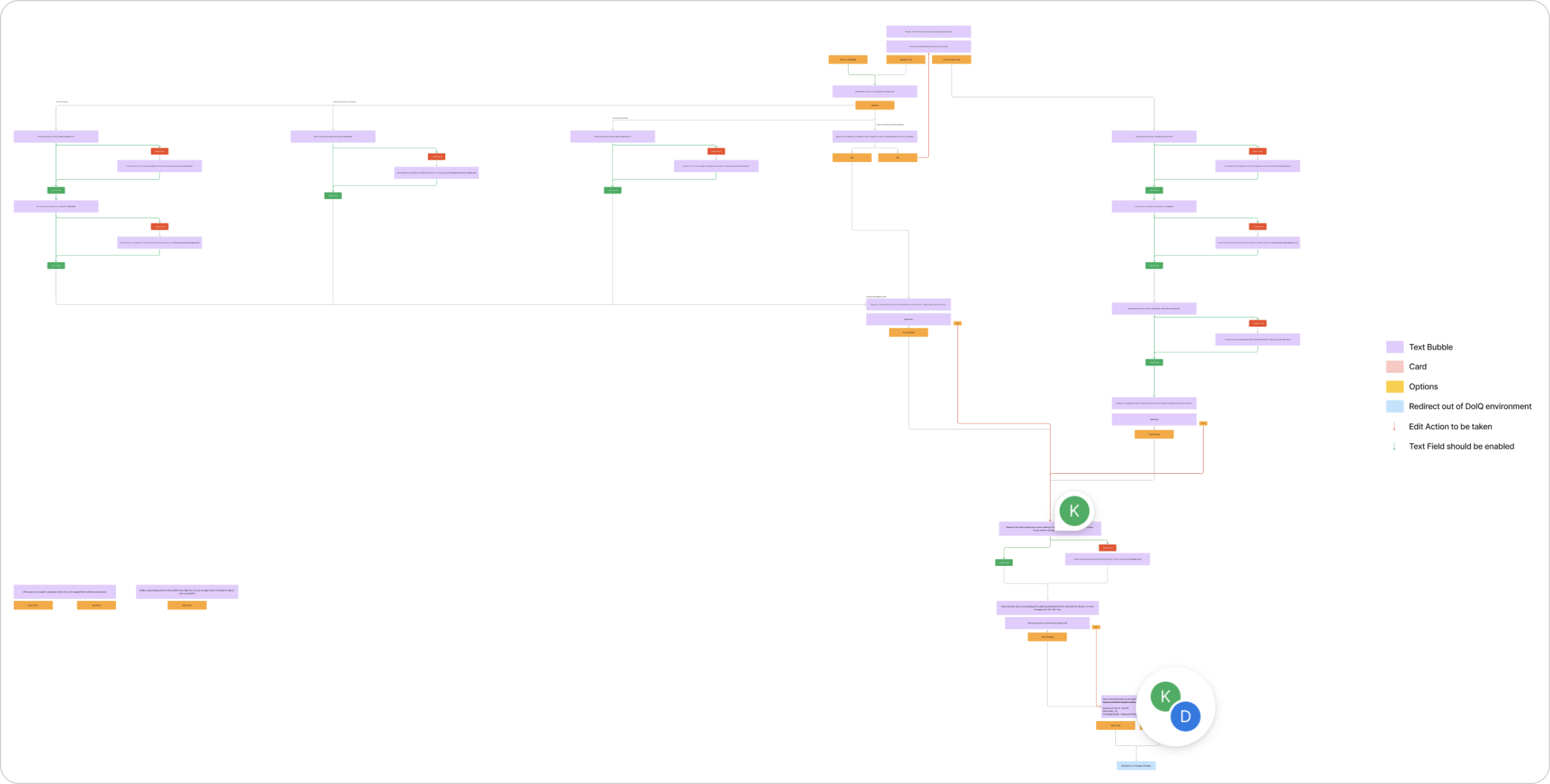
process.
In response, the flow was simplified into a single-step conversational interface that asked recruiters for role name, years of experience, assessment duration, must-have skills and good-to-have skills. This felt intuitive and significantly reduced friction, but cracks appeared quickly once the system was used in real hiring scenarios.
early feedback.
Feedback from recruiters and hiring managers revealed deeper issues:
- AI struggled to map question difficulty accurately to seniority
- Library questions weren't reliable enough to stand alone
- Skill inputs lacked depth — AI needed sub-topics, components, and responsibilities
- Job responsibilities were missing, limiting contextual understanding
- The assumption that recruiters were the sole persona was flawed; hiring managers still needed visibility and validation
The system demonstrated intelligence, but without sufficient contextual grounding, it couldn't be trusted to operate independently.
second iteration: can structure improve intelligence?.
We shifted strategy: instead of relying on the library alone, we asked recruiters for richer structure. This helped AI reason better about:
- Skill relevance
- Question selection
- Difficulty mapping
However, we created a new problem.
what did we learn from the second iteration?
The process worked — but at a cost.
- Recruiters found it too long and mentally taxing
- Assessment timing wasn't factored early
- Skill weightage wasn't adjustable
- Question distribution felt opaque
- There was no way to control question types (MCQ vs coding)
We had optimized for AI accuracy, but compromised UX efficiency.
third & final iteration: how do we balance speed, control, and intelligence?.
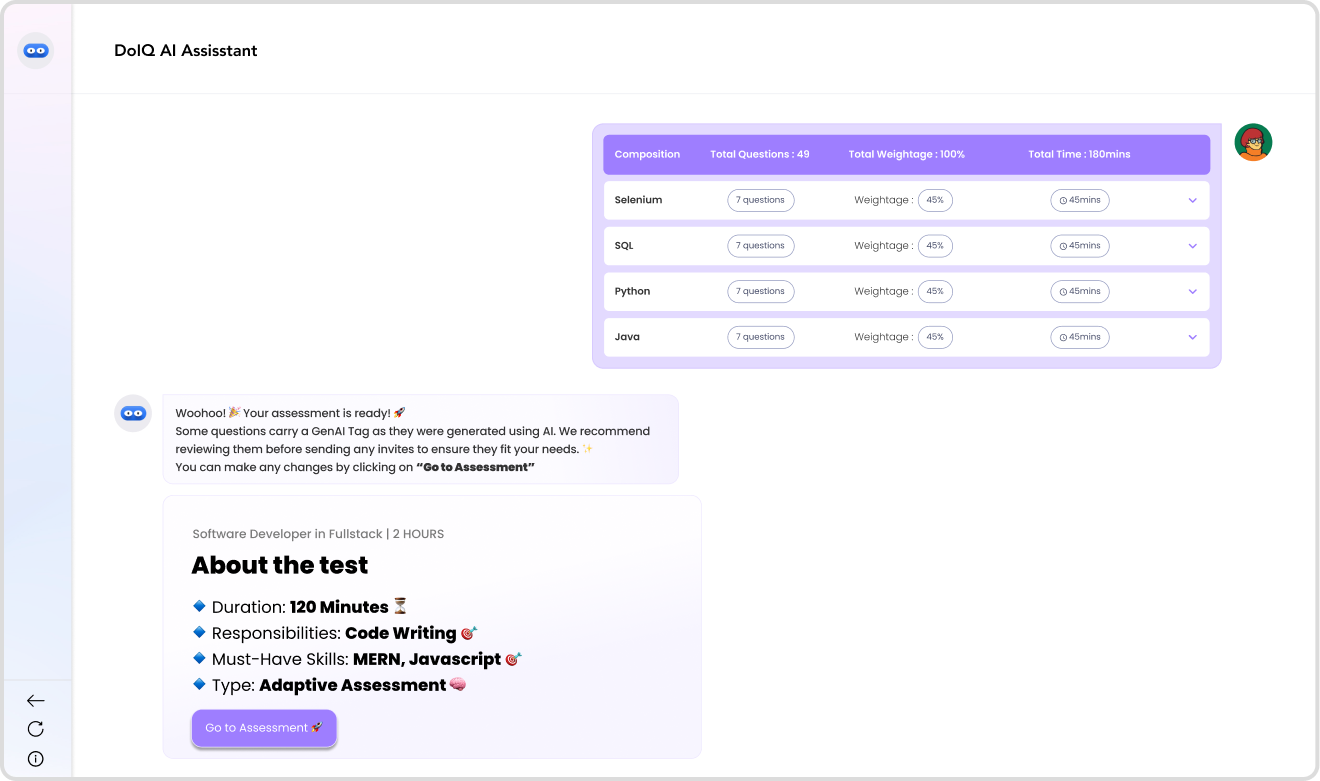
The final direction reduced complexity while increasing clarity. The entire flow was condensed into three structured steps:
- 1.Upload job description — used as a reference, not a dependency
- 2.Confirm role and experience — helps AI reasoning and difficulty mapping
- 3.AI-assisted skill mapping table — this became the heart of the experience
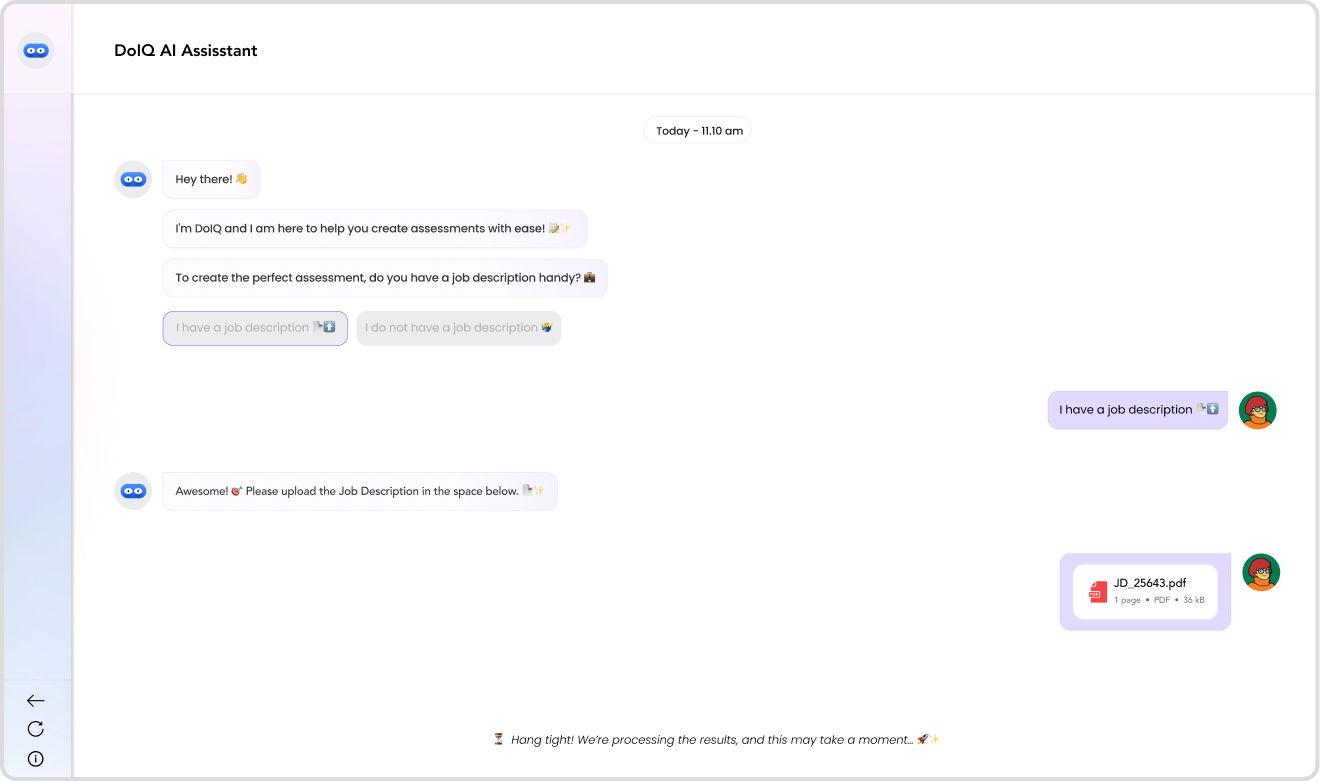
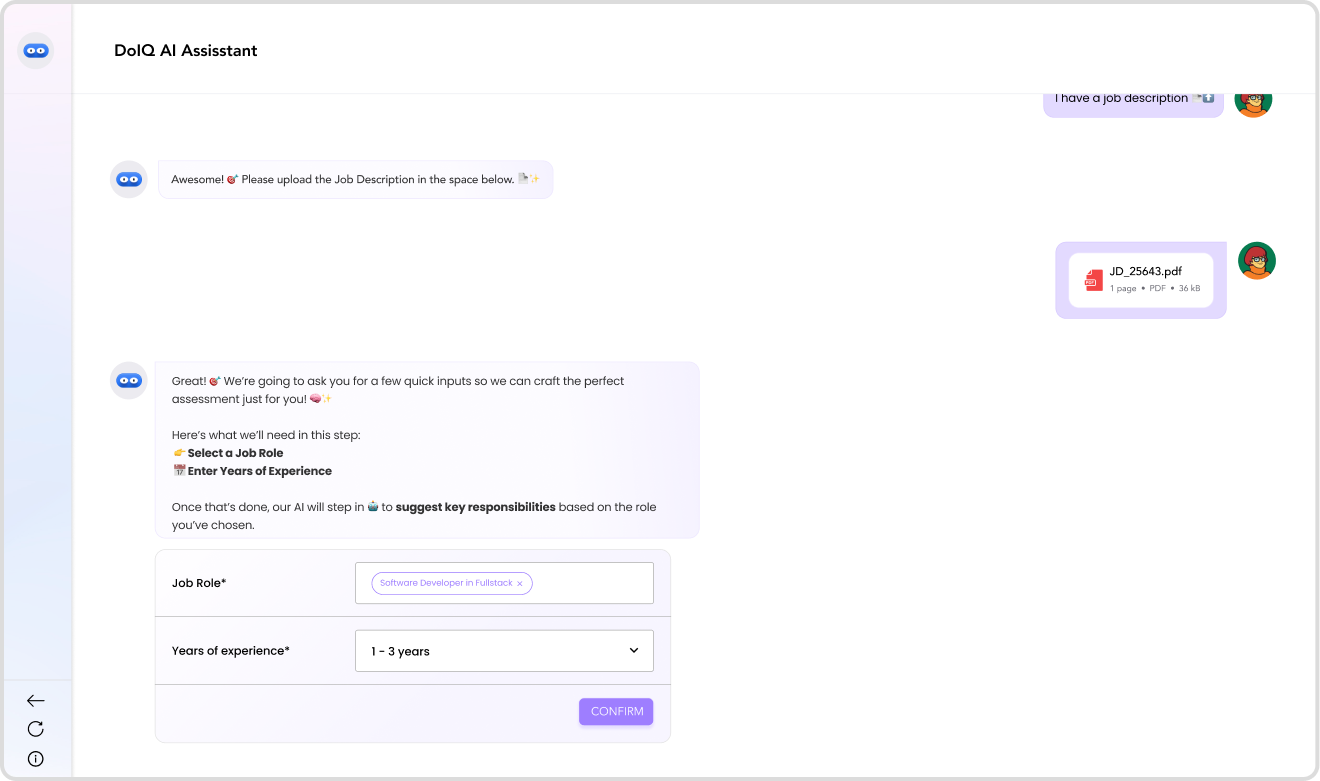
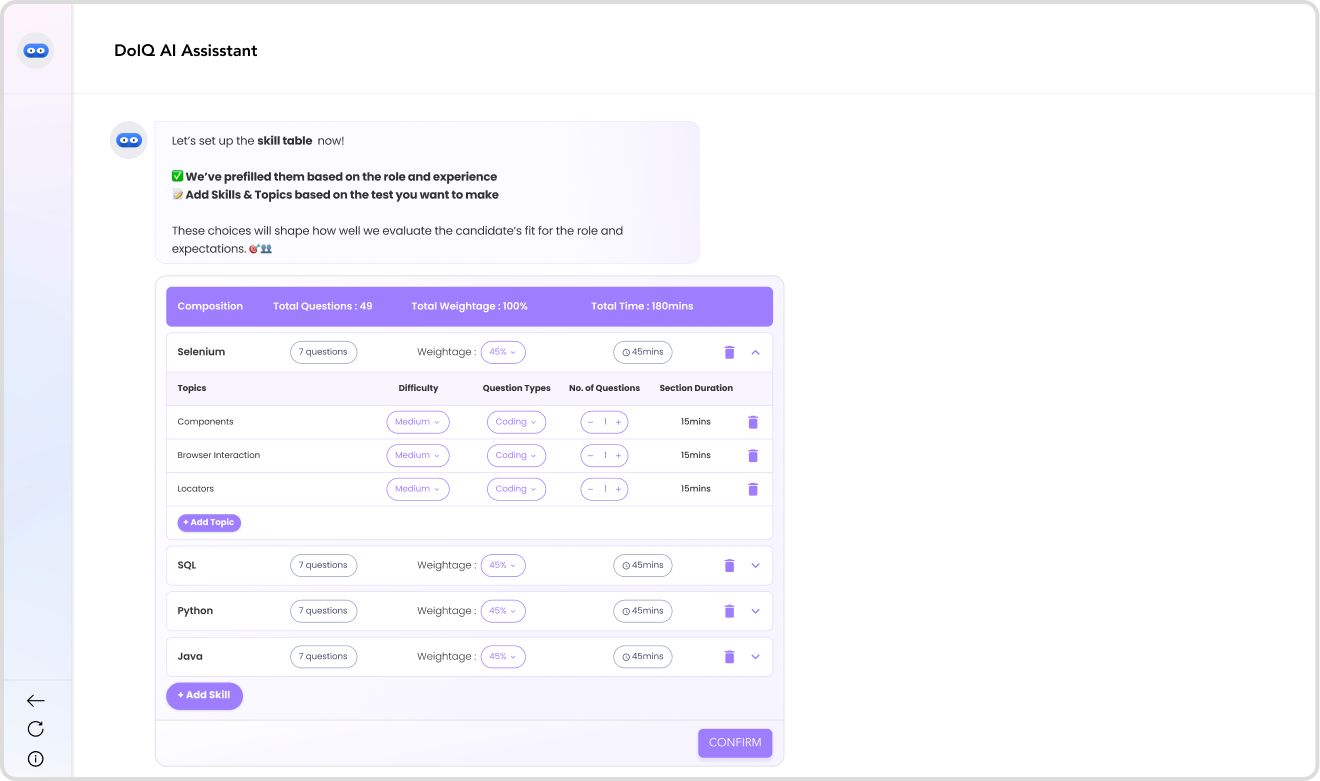
 step {{ stepNo }} / 4
{{ stepTitle }}
{{ stepDesc }}
& Voila! Your assessment is ready to be taken.
what unexpected opportunity did this unlock?.
While refining this system, we identified a new assessment type: Adaptive Assessments.
- Each skill contains questions across difficulty levels
- Candidates start with easier questions
- AI dynamically adjusts difficulty based on responses
This enables one assessment per role, more accurate skill measurement, and strong applicability in Learning & Development use cases rather than recruitment.
This insight emerged directly from system-level UX thinking, not feature requests.
what was the impact?.
প্রভাবimpactClient accounts — 20,539 total questions · MCQs: 19,941 · Coding: 598
Internal accounts — 8,350 total questions · MCQs: 7,955 · Coding: 395
Internal teams began creating assessments independently using DoIQ Assessor, validating the self-serve vision.
Clients reported:
- Less need for question verification
- Higher confidence in AI-generated assessments
- Faster turnaround without C&D dependency
what did this project teach me?
শিক্ষাlearnings- ▸How deeply UX and AI systems are intertwined
- ▸How prompt design influences product outcomes
- ▸Why MVPs feel uncomfortable — but work
- ▸How to design for trust, explainability, and control in AI products
- ▸How self-serve UX drives adoption in B2B SaaS
Most importantly, it reinforced that good AI UX isn't about replacing humans — it's about augmenting decision-making with clarity and confidence.
Back to portfolio
← All workNext case study
Doselect Access Management ↗︎