ai interviews.
এআই সাক্ষাৎকার AI InterviewsRole
Lead UX Designer
Company
Naukri.com / Doselect
Timeline
2024 · Ongoing
Tools
Figma · Jira
why was this worth solving?.
সমস্যার মূল্য value of the problemFrom recruiter interviews and sales feedback, we observed that early interview rounds were increasingly being deprioritized by hiring managers.
- 7 out of 10 recruiters said first-round interviews mostly focused on basic validation like communication, fundamentals, and intent
- Most recruiters estimated that despite being simple, these rounds consumed roughly one-third of total interviewer time per role
- Several recruiters shared that senior hiring managers frequently delayed or skipped first rounds, directly impacting time-to-hire
In parallel, recruiters mentioned that DoSelect's Manual Interviews were increasingly replaced by Google Meet / MS Teams with plugins, which led to:
- Lower repeat usage of Manual Interviews
- Reduced perceived differentiation from generic meeting tools
- Drop-offs after interview scheduling
Together, recruiters described first-round screening as a high-effort, low-value bottleneck, making it a strong candidate for automation.
Across recruiter interviews and internal usage reviews, three issues consistently surfaced:
high interviewer fatigue.
- ▸Most recruiters said hiring managers spent multiple hours each week on repetitive first-round interviews
- ▸Several recruiters mentioned that once managers evaluated 10–12 candidates for a role, interview quality dropped or interviews were postponed
longer time-to-hire.
- ▸2 out of 3 recruiters reported that first-round scheduling alone added nearly a week in bulk hiring scenarios
- ▸These delays compounded when interviewer availability was limited
inconsistent evaluations.
- ▸More than half the recruiters said the same candidate could receive different outcomes depending on the interviewer
- ▸Feedback quality varied widely based on interviewer context, mood, or time constraints
Manual Interviews reinforced these problems by requiring constant hiring manager involvement, making the system slow, dependency-heavy, and difficult to scale.
what did we set out to change?.
পরিবর্তনchangeBased on recruiter expectations shared during interviews, we defined success as:
- Reducing recruiter coordination effort in early screening
- Bringing first-round turnaround time down from days to hours
- Standardizing evaluations so candidates could be compared reliably
- Improving candidate completion through asynchronous, flexible interviews
- Retaining recruiters within the DoSelect ecosystem instead of external tools
what did we need to learn first?.
শিক্ষাlearningBefore designing solutions, we aligned on a few key research questions:
- Why did recruiters stop using Manual Interviews after initial adoption?
- Which interview steps required the most effort but contributed the least to decision confidence?
- Where were recruiters comfortable allowing AI to replace human effort?
A recurring theme across interviews was reducing dependency on hiring managers for question creation (which often delayed the process by 2–3 days) and first-round evaluation, which was often rushed or skipped.
how did we approach research?.
গবেষণা পদ্ধতিresearch approachWe triangulated insights from multiple sources:
recruiter interviews.
10+ recruiters from active DoSelect customers · 6 recruiters from churned or low-usage accounts
stakeholder discussions.
Product and Engineering teams · Sales feedback from lost or stalled deals
internal data reviews.
Interview setup drop-off points · Average time-to-hire by role type
This helped confirm that patterns were consistent and not anecdotal.
what patterns emerged from research?.
নিদর্শনpatternsFour insights strongly shaped the product direction:
introductory screening is the highest ROI use case for AI.
- ▸Around 7 out of 10 recruiters said they were comfortable using AI for first-round screening
- ▸Only 1–2 recruiters expressed comfort with AI making final hiring decisions
hiring managers actively avoid early-stage efforts.
- ▸More than 8 out of 10 recruiters said managers did not want to write interview questions
- ▸Roughly two-thirds said managers preferred not to evaluate early-stage candidates
bulk hiring amplifies inefficiencies.
- ▸Recruiters handling 50–200 candidates per role were the most vocal about delays and fatigue
- ▸These recruiters perceived AI-led screening as the highest value
trust is non-negotiable.
- ▸Nearly every recruiter interviewed raised concerns around impersonation, plagiarism, or misuse
- ▸Proctoring was consistently described as a baseline requirement
what approach did we choose and why?
পদ্ধতি নির্বাচনchoosing the approachBased on recruiter confidence levels, we committed to an MVP-first, scalable approach focused on automating introductory screening, covering roughly 60% of early-stage effort.
Key decisions informed by recruiter interviews:
- AI Interviews handled introductory validation only
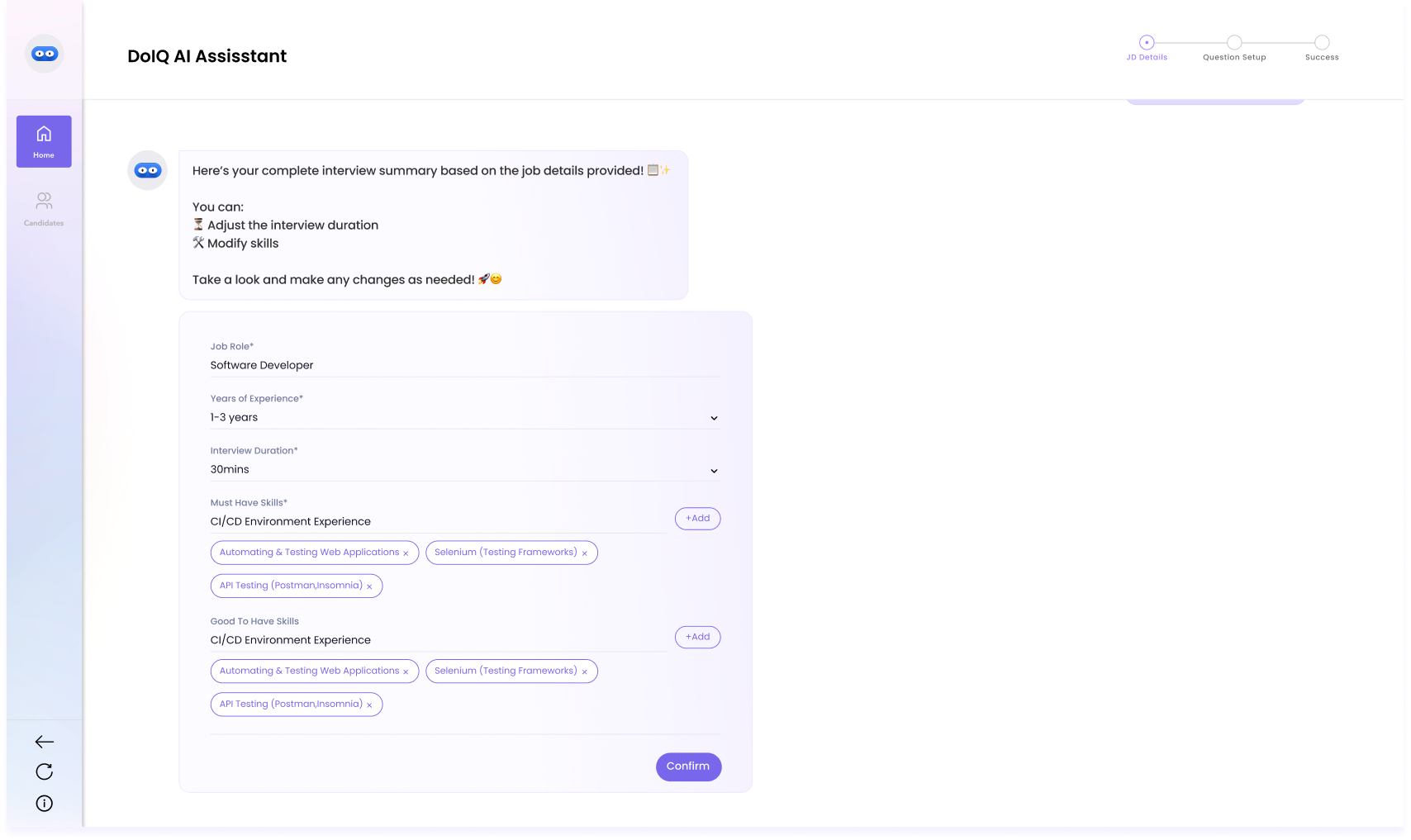
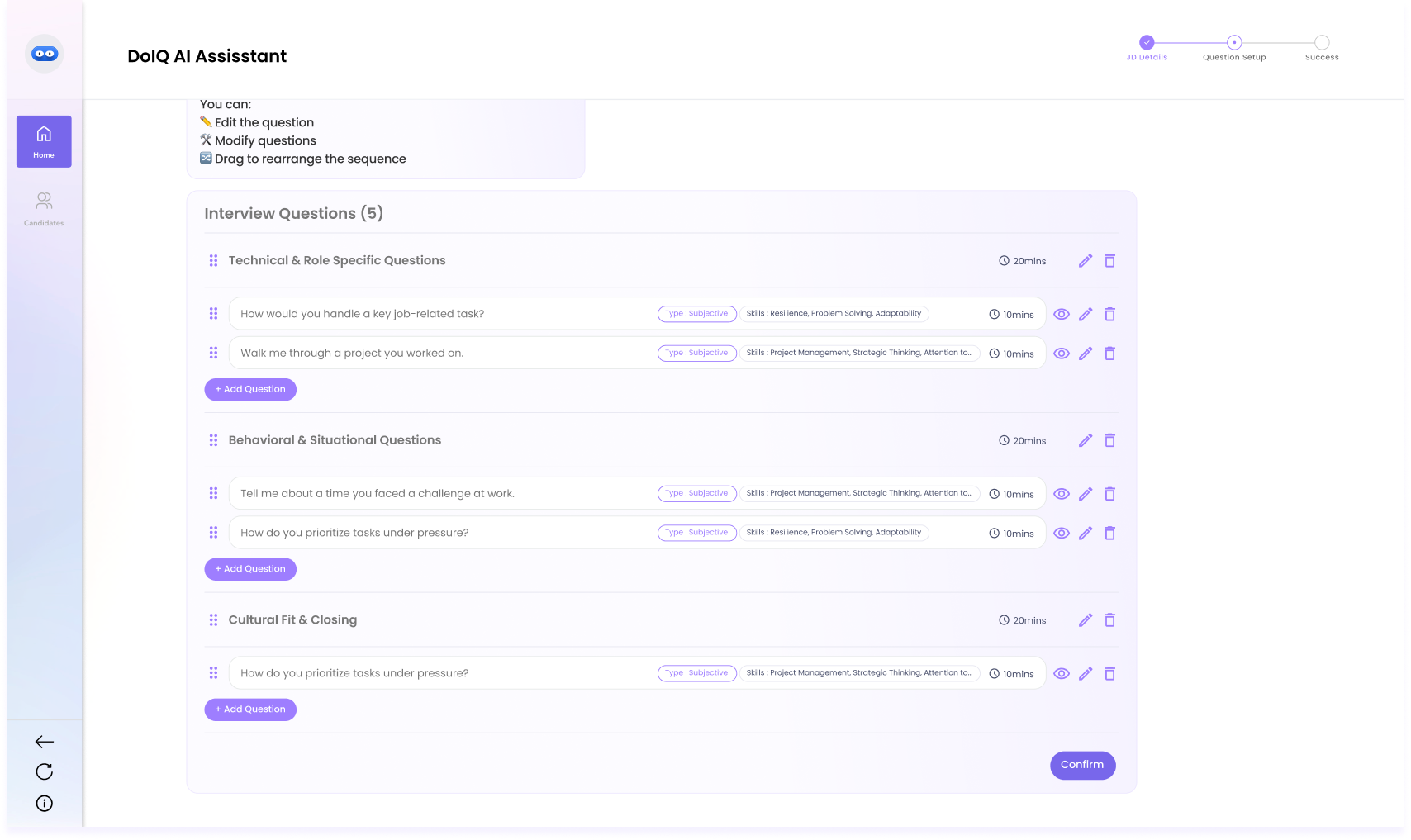
- Questions were dynamically generated using role, experience, and skill expectations
- Evaluations were structured and explainable, with scorecards preferred over free-text
- Recruiters could complete setup independently, in under 10 minutes
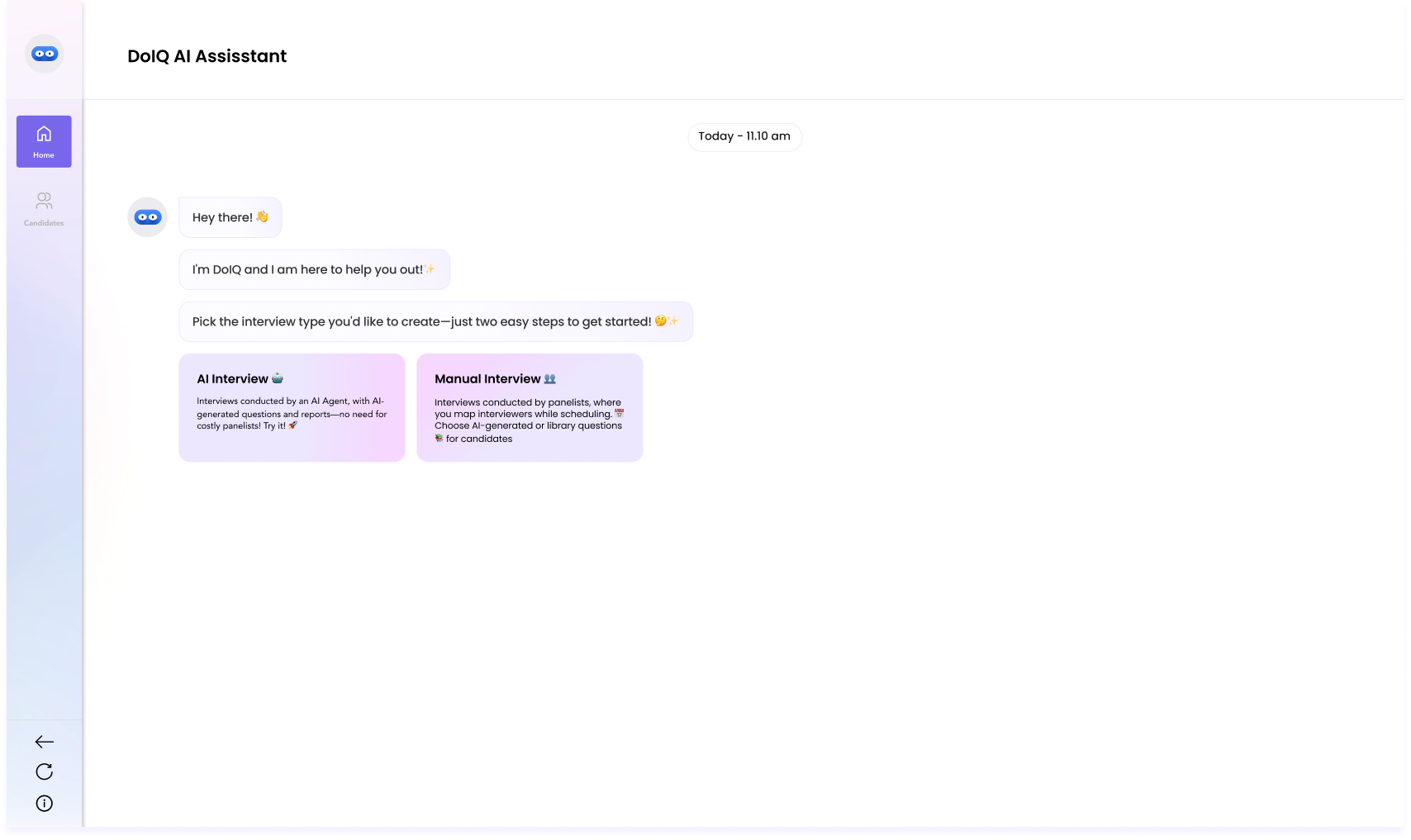
We chose a conversational chatbot flow over forms because recruiters naturally described hiring needs conversationally and found long forms exhausting during high-volume hiring.
What interviews and testing revealed:
- Recruiters thought through role expectations before exact questions
- 2 out of 3 recruiters reported form fatigue
- Progressive refinement of inputs was preferred
- A DoIQ-powered chatbot enabled ~30% faster setup, fewer post-creation edits, and higher confidence in AI-generated questions
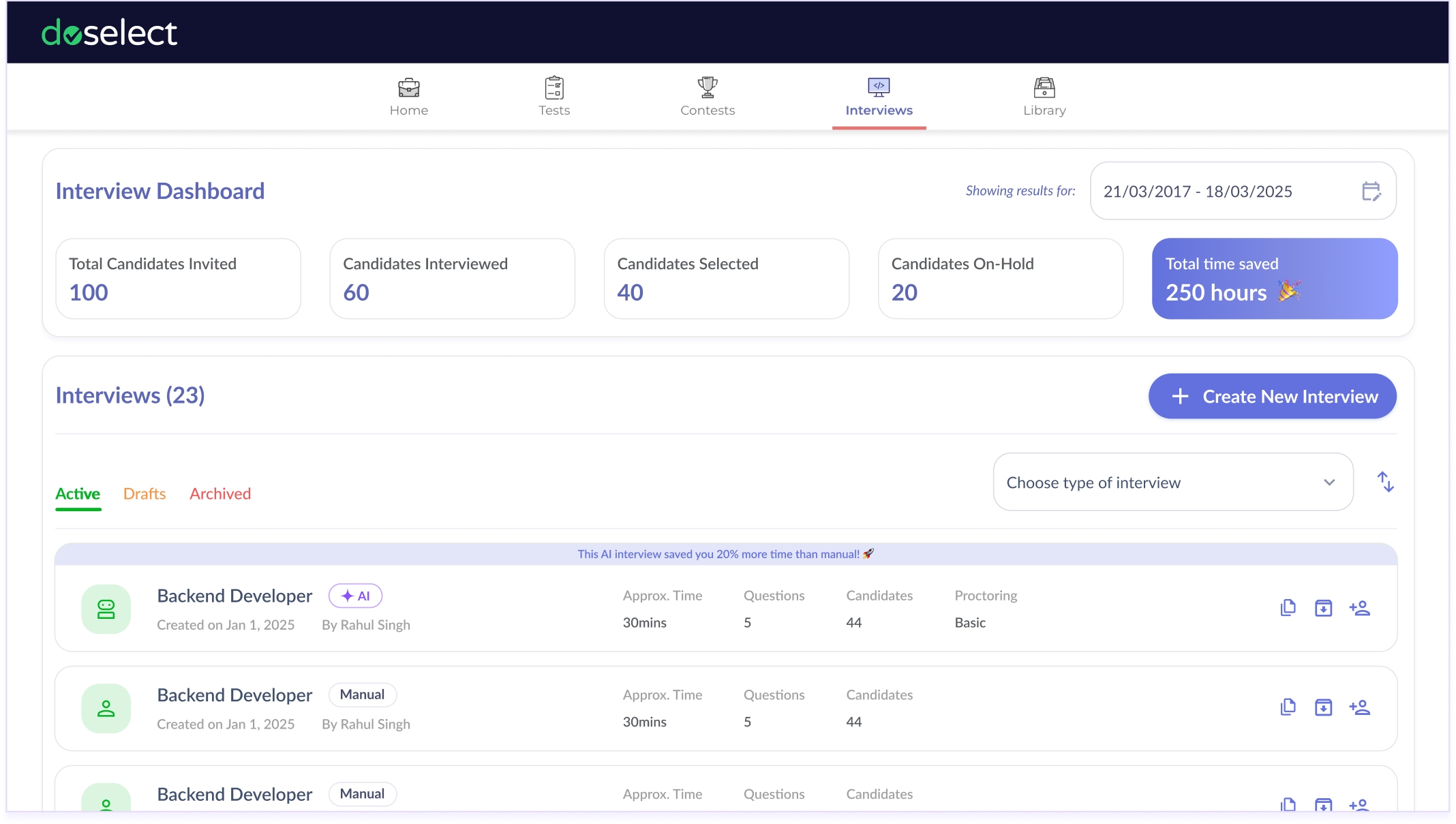
interview dashboard.
সাক্ষাৎকার তালিকাinterview dashboardWe designed a dashboard to manage AI interviews, aimed at improving efficiency and nudging recruiters toward AI adoption by clearly highlighting its time-saving benefits.
Key features:
- Funnel View: Shows interview performance across stages to help recruiters track outcomes quickly
- Interview States: Draft – creation in progress · Active – candidates invited · Archived – completed processes
- Clone Option: Easily reuse and modify past interviews
chat based interview creation.
কথোপকথনconversationWe replaced complex form flows with a conversational interface (DoIQ) — guiding recruiters through interview setup step by step. Upload a JD, get a complete interview in seconds.
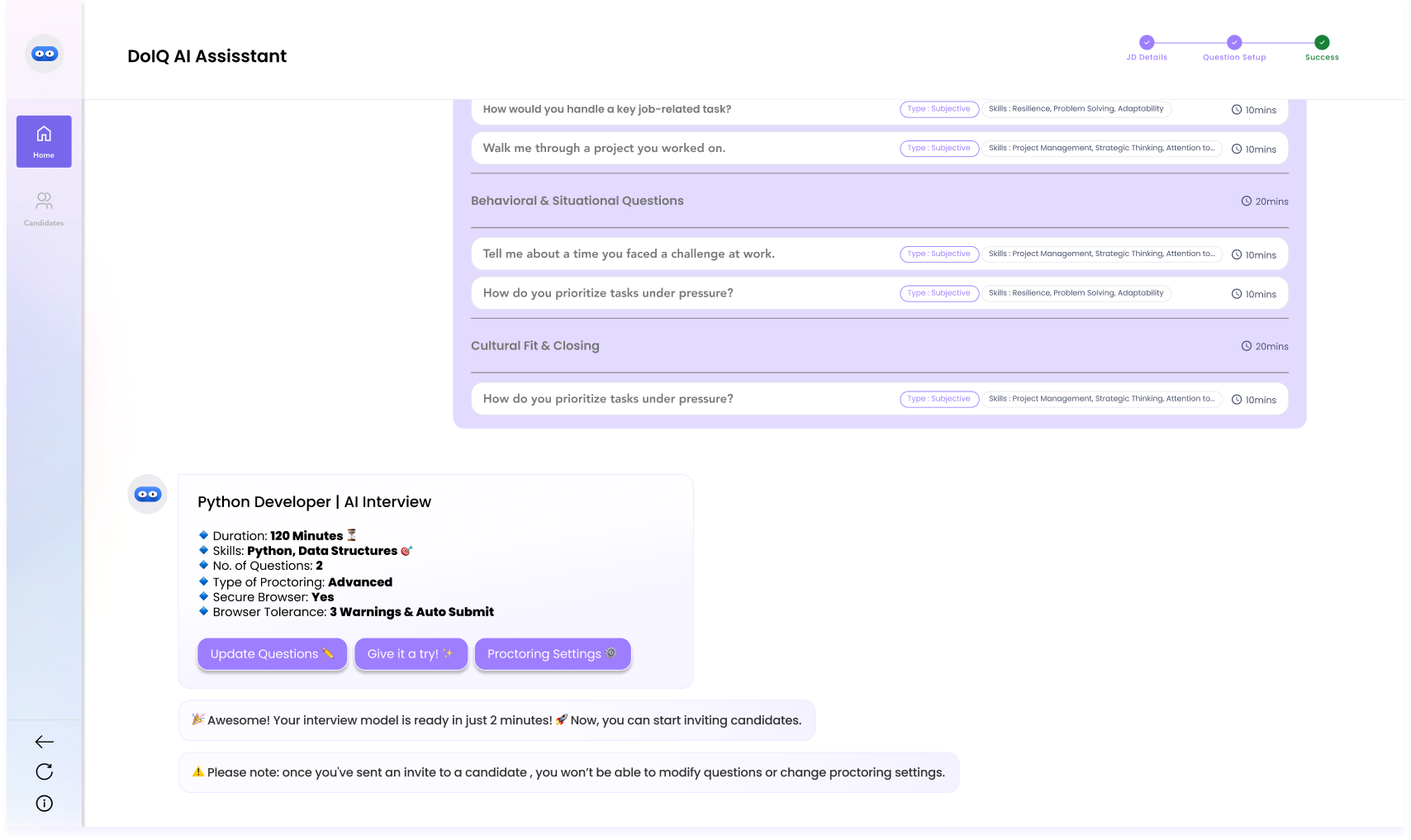 step {{ stepNo }} / 4
{{ stepTitle }}
{{ stepDesc }}
ai-powered evaluation interface.
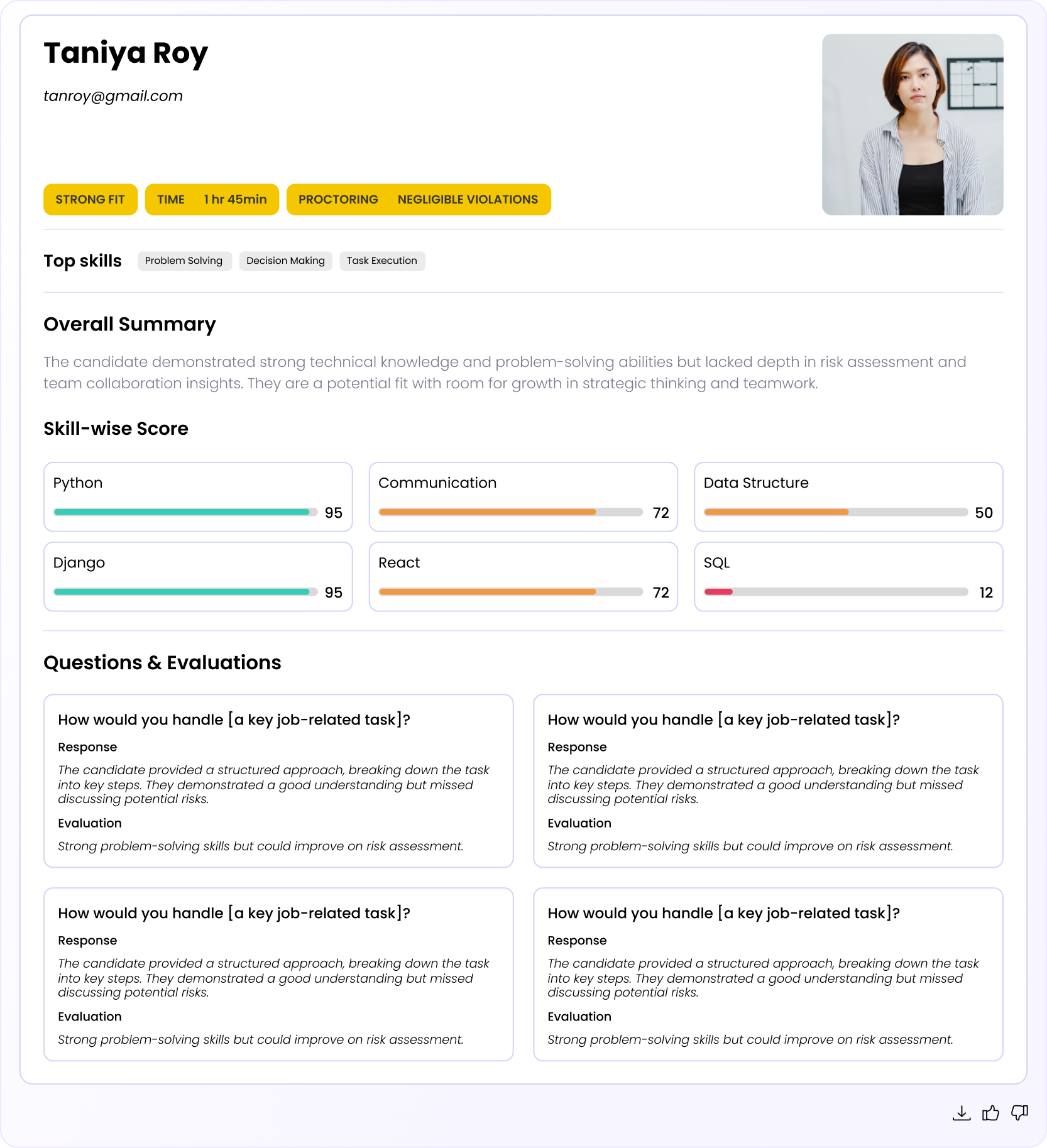
মূল্যায়নevaluationTo assist recruiters in faster, more objective decisions, we designed a smart evaluation layer post-interview completion.
Automated Insights: Each candidate response is AI-evaluated with:
- Summaries
- Confidence scores
- Key behavioral highlights (tone, keywords, pauses)
Proctoring Layer: Every video is scanned for violations:
- Face absence across frames
- Presence of multiple faces
- Tab switching and application focus loss
candidate management tool.
প্রার্থী ব্যবস্থাপনাcandidate managementA unified view of all candidates invited to an AI interview — their status, scores, and actions — in a single scrollable list.
- Filter by interview status, score band, or completion
- Bulk invite and shortlist directly from the list
- Export scorecard data for stakeholder review
how did candidates experience AI interviews?
প্রার্থীর অভিজ্ঞতাcandidate experienceEarly candidate feedback influenced refinements to the AI agent:
- Several candidates expressed nervousness when interacting with AI
- Pauses were often perceived as failure
- Overly robotic responses reduced comfort
Key UX decisions included:
- Regional tone and friendly phrasing
- Smart fillers during pauses
- No answer leakage
- Optional feedback on request
Recruiters later reported fewer candidate complaints post-interview.
what changed after this went live?
পরিবর্তনwhat changedBeta outcomes
- Naukri internal teams adopted the product for pilot usage
- 6 companies invited multiple candidates during beta
- 70+ candidates were interviewed internally
Recruiter feedback highlighted:
- Recruiter involvement reduced by a lot
- Faster shortlisting cycles
- Improved consistency in candidate evaluations
what worked—and what still worries us?
সাফল্য ও শঙ্কাsuccess & worrywhat worked well.
- ▸End-to-end interview creation without hiring manager involvement
- ▸Structured AI-driven scoring improved decision clarity
- ▸Chat-based creation significantly lowered setup friction
- ▸Proctoring increased trust in AI-led interviews
open challenges & learnings.
- ▸Some candidates remained skeptical of AI evaluation
- ▸A few recruiters raised concerns around transparency
future opportunities.
- ▸Stronger explainability of AI scoring
- ▸Hybrid AI + human validation for borderline candidates
Back to portfolio
← All workNext case study
AI Assessment Creation ↗︎